
bite sized: ideals
Transcript
Hey loggers, welcome back to another bite sized episode of the Backlog Breakdown. Bite sized episodes are where we take a single concept and kind of kick it around for a few minutes. They're bite sized thoughts, they're not an hour and a half, which I'm sure you could already see when you pulled us up on your podcast player on YouTube, anything like that. Anyways, these are thoughts where we don't really, we have not really dug into these concepts or these ideas or just, just kind of presenting something. And hey, we'd love some feedback, we'd love some conversation on some of these things. And so today's bite sized I've titled Ideals because I wanted to talk about the concept of Ideals. And really it is kind of branching off of our last episode where we talked about being engaging with video game culture wisely and well. And one of the ways I think we can do that when we analyze video games or storytelling in general. So I'm going to go back and forth between a bunch of different types of media today when we talk about idealizing certain things. But one of the ways that you can analyze media is by what this, this piece of media idealizes. What is it? What is the. Some of the questions that we'll take a look at are what are the character motivations? What are character desires? What does the story tell us is good? So underneath the surface, it doesn't have to, you know, come out and say it on the nose, but what are, what are your main characters kind of searching for? What are they attempting to do? What does even the way that they interact within the world interact with other characters, even the way that they present themselves? What does that say about what is good and true and beautiful in this piece of media? And the reason I wanted to talk about this is because on our last episode, when we asked, you know, how do we engage wisely and well, we recognize that we can kind of easily jump on bandwagons and things that are going on within the space. We can jump to conclusions improperly sometimes. But I do think the other side of that is we want to be wise. And so we do want to pick up on not just what video games overtly tell us, okay, with their, with their stories, with their characters. But we want to go a little bit deeper and we also want to see what, what is this game telling me or what is this piece of telling me is good and true and beautiful, even if it's not overtly expressed. And hey, this can range depending on the video game that you're Playing on the type of media that you're engaging with, because we know we've said this multiple times on the podcast before, is just that there are popcorn flicks, right? There are movies that are just big dumb action movies that are. That are just fun to watch because you get to see justice enacted, right? You get to see things blow up. You get to see bombastic things that you wouldn't see in real life. There are also video games that are just for fun. You know, what is the character? What is Mario's character motivation? He just wants to save the princess, which when we analyze that type of ideal, hey, Mario is a good character. You know, he's. It's not, it's. It's not that even he's. He's doing it necessarily for a particular romantic love. Although you do see, you know, the. At least that Princess Peach and Mario have a relationship, but he's just doing it because it's the right thing to do. And so you're idealizing in Super Mario Brothers the fact that, hey, there is work to do and Mario's going to get it done that this princess needs to be saved. And for the good of the Mushroom Kingdom, Mario is going to save the princess from King Koopa. So anyways, there are very thin levels of idealization like that. You know, there are games that make it very on the nose as well, where characters proliferate about their ideals and what it is they're trying to accomplish. And there are other games where the ideals are more hidden and perhaps it takes a more emotional attack. Rather than saying that this is good on its face. A game may. May say that subtly and have you feel something before you actually think about something. So I think of a modern game and I'm going to spoil it a bit. So I apologize. I say modern just because it's not retro, but something like Gone Home, which is a game that I have a lot of problems with and it's primarily because of what it idealizes that although the, the function and the mechanics of the game, this walking simulator game, it. It does a good job of relating the story through objects in rooms, through. I think it's storytelling. The way that it tells the story is. Is done very well. I think the story that it tells is very emotional. It tries to wrap you up in its emotions and make you feel the emotions of the characters. The. But the ideals kind of undergirding those emotional. The emotional impact of the game, I think are faulty. I think the game idealizes personal self expression and modern ideas of gender and sexual orientation that I think are wrong and detrimental. And it also, not only does it idealize that personal expression, but it idealizes that over those that ought to be protecting you, like your parents, you know, and their ideas and what they do. Obviously it is going to downplay any good aspects of the antagonist in something like this. And so I don't quite remember, you know, how overbearing the parents were. I'm sure that was part of it. Every teenager feels that way, you know, about their parents or authority figures. But when we denigrate authority and instead prop up and idealize our own personal self expression, especially when it's modern notions of things that again, I think as Christians we can say are wrong, the ideas of gender orientation that is not, not even necessarily fluid in this game, but that we need to be liberated from, from ideas of, of sex and gender that there's only, you know, that, that males and females are, were for each other the way that scripture tells us. And so you take a look at a game like that and you see what it idealizes. And so because it's a story driven game, I don't really like that game, even though I think it does some things very well. And I think we can do this when we take a look at the ideals of games. When we take a look at the ideals of characters, again, we can take a look at character motivation. We can take a look at their desires and what it is that they want to accomplish, because that can subtly teach us as players, especially as we seek to, or not even seek to. But what just happens because of the medium of video games is we embody these characters, right? And so if you're not playing kind of a your own avatar in a game, you're playing a pre written character, then when you embody these characters, sometimes we have a tendency to just sympathize with them because we're playing as them instead of critically analyzing, oh, what is, what is this character like? Do I, do I actually agree with this character's motivation, what they're trying to do. Sometimes we play. Here's another game that just popped up into my head because this is a nice rambly episode of the bite sized backlog breakdown. Here is a game like Persona 5 where you embody different characters. And that's another game that I think actually has some issues with its motivations and its characters. You can understand and you can sympathize with the character motivations. Oh, we need to take down these people in authority who are using their authority wrongly. Okay, I can get with you that far. What does justice look like, you know, when we feel like we're chained down by authorities that are, are abusing those that are under them? That's a good premise, though. That's a good kind of start to a story. But the answer that's presented in that game, taking justice into your own hands and especially the way that you do that and the way that that game kind of builds into an idealization of chaos and anarchy and everyone does what is right in his or her own eyes. The way that the, the way that humanity was when God judged them with the flood of Noah. That is not a good answer. And so while I do, I, I do actually like that game, I also recognize that there are problems with it because the ultimate answer that it gives you, and that's over the course of, you know, 120 hours or so, the ultimate answer is not a good answer. It doesn't, it doesn't idealize. Excuse me, what is actually true and good and beautiful. And so as Christians, we need to be careful. I'm not saying don't play these games, but I'm saying that we ought to be. How do we engage with this medium? Wisely and well. Well, I think there needs to be something to be. There is something to be said about what video games, what particular games idealize. Now, I think the medium of video games does have some unique aspects to it. With any visual medium, you are going to have characters that are portrayed to you. Sometimes even the way that those characters are portrayed, their dress, their body type, their figure or the way that they walk or something like that, sometimes that will signal their ideals as well. And so we do want to be careful with how we engage with things. What is it that this character is telling me? And I'll say for me, one of the things that I didn't realize until I was an older person I just kind of accepted as true is that anytime that you, anytime that you exaggerate the bodies of males or females, that you are objectifying those characteristics and you are objectifying these people and they're no longer people, they're objects because you have exaggerated certain parts of their bodies. I think that is a very simple way of looking at things that I don't find to be altogether true in every circumstance. I do think it's, it's, it's true in some circumstances. I think there are some video games that are just trying to be that. That will exaggerate more sexual parts of the human body in order to, in order to simply allow you to sexualize certain characters. And I, I don't cosign with that. Okay, so there is certainly a warning on that end. But I do think that there's something to be said about what does the. Why do characters. Why are they idealized in their. Their form? So I've, I talked about on the previous episode where I've been watching through the 92X Men cartoon and everyone in that show is absolutely jacked. I mean even my daughter was like, that guy has a nine pack. And I think he was. I think she was talking about Wolverine. But even like, why can't I think of his name? Sabretooth is just like absolutely stinking ripped. Like everyone in that show is ripped. Now, do they do that just so that you can objectify the male form and you can look at these people like pieces of meat? No, I don't think that's the case. I think in the superhero story what they're trying to communicate is that these people obviously have superhuman powers, but we want to idealize our heroes. And so while I might not ever me, Josh Broccolo may never have a nine pack, which I'm pretty sure I'm not ever going to, I, I do want to strive to be like these heroes. And so what is propped up as ideal is that they have strength and power and that they use that strength and power to protect, to serve, to provide for others, to lead their teams and to use that power to fight against, you know, the bad guy characters, to. To protect the world and their team and those whom they care about. And so I think it's not just in the answer. There is not just that we objectify these things, but that, no, there's actually something good in these physical forms that we want to say. And that is to say it is a good thing to be strong. It is a good thing to build muscle, particularly for men to build muscle so that they can use their God given strength to protect those around them. And I think on the other side, hey, touchy subject here for the female form with this classic kind of hourglass figure that's propped up with again, taking like superheroes or something like that, where yes, some of the time the, the more hourglass figure is simply used to catch your eye. Okay, I understand that. And to that degree it, it's not good. Okay. But I do think there is something to be said about exaggerating female characters and their form, certain parts of their body that are built for bearing and nurturing children. So hips and breasts. I think when you exaggerate those things on women. Sometimes that is done to show that this character is actually nurturing. To show that this character is femin. Now again, I'm not saying like, hey, skin tight suits and low cut shirts and things like that are. Do that well or that presents that ideal. That is not what I'm saying. And again, I have to say it again insofar as you are simply exaggerating that. So to catch the eye of people, that's wrong. So there's a fine line between this objectification gets crossed all the time. Okay. But I do think there's something to be said about when you start tearing down these ideals and making characters and presenting characters as more androgynous. You start taking away the muscles, particularly in men. You start taking away the feminine form of your female characters. I do think you lose that idealization and things become bland and gray and their bodies are no longer teaching about their character, which I think you can actually do really well if, if that's part of who these characters are. You can even do that with, you know, the classic kind of femme fatale, anti, not even anti hero, excuse me, antagonist that, that uses and seduces other people and that, that shows us that yes, women have an inherent beauty that they can use to catch the eye of men. That is attractive, but when you use it improperly and you become a bad guy, right? So you can teach even ideals through the reversal of those idealistic properties. Obviously with men and strength and power, you've got your overbearing rulers, right? People that are just searching for that power that, yeah, he might be Jack, but he uses that strength for himself. So the last thing I want to touch on is. So there's, there's this visual aspect I think too of idealization and this modern notion of no, let's not, let's not actually use those ideals anymore. Let's make everything more bland and boring and wimpy in certain ways. Let's not teach through the way that we show things. I think video games can particularly show this even by, you know, combat. And who, excuse me, who are the most powerful characters in the game? That teaches something, right? That teaches us ideals. What, what are the different powers that different characters have? How do they attack other characters? What do they do? Do you have, you know, who, who is the healer, right? In, in the group, who is more nurturing? What kind of ideals do you want to have? Is a game is, is the ideal that this game is teaching that, hey, violence is, is the answer to absolutely everything which, you know, with video Games, That's. That's generally the case. Or again, what characters are more powerful than other characters? I played a game recently where the main two characters seemed to. The. The story seemed to say, oh, these are the most powerful characters, you know, ever. But then anytime anyone would join them in their party, they'd all have pretty much equal strength. And you know, the strength scaling between bosses and regular enemies wasn't that large. And so there's a bit of dissonance with that as well. So these are some things that we can analyze as we take a look at the ideals of different characters. I do want to give two kind of modern examples I think of, of poor storytelling and poor idealization, one of which is kind of your classic Disney movie. When you analyze character motivations and what is being propped up as ideal is this, is this again, I would say modern, you know, maybe 90s, whatever. This trope of, of the princess wanting to get away from the. Get away from royal life, you know, run away from her parents because her parents are just overbearing. And I don't want to be a princess, I want to kind of live on my own. And I think you can see that in a number of different kind of Disney stories. And when you analyze that as the ideal now. Yeah, well, I'll take that in just a second. When you analyze that motivation, that's actually a pretty poor motivation that actually teaches us as a people, teaches children that you should. That it is good for you to find self expression, find self fulfillment in rejecting the ideals of your fathers and mothers, of your authority figures, of those who are. Who are over you and have chosen a certain way of life for you. That is not actually a good ideal that I want to teach my children. Now what I was saying earlier that I. That I didn't want to get around to until I explained it is that just because a character starts one way does not mean that that character ends that way. There is a narrative arc. And if that character starts with improper ideals, that's okay so long as they correct those by the end of the movie. And in that case, I mean, that's actually a good thing because then you can show, hey, the faulty thinking, the flaws, the naivete of children who go against their parents ideals because they don't know what the world is actually like. And so then the story can be a good story. And then you can see, oh, the ideal presented here was not actually the character's original motivation. That was just the setting so that you can go against that to teach a true and Good and beautiful. Ideal. So it doesn't always. Even though character motivations can point us towards ideals within a narrative arc, it can end up being something. It can end up being something much better. The last thing that I'll talk about, the last kind of example that I want to show is with a lot of modern storytelling, and I think video games in particular is, you know, I talked about how there. There's a visual element to certain characters that can teach us about their ideals. And I think there's a modern notion. I say modern. Take this with a grain of salt. A lot of current video games are moving away from idealizing your main characters and instead would rather show the player on screen. And so protagonists have to be relatable in a number of different ways. They have to be uninteresting or kind of the kid thrown into all the craziness, as opposed to having someone who is more idealistic, who can show us the right way. Oh, they need to be a confused kid. And they can't show, you know, strength or power or morals or things like that. No. Because it needs to be more gritty and more real life and more. It needs to be more similar to our experience here on Earth. And while I think that can make for an interesting story, okay, I'm not saying I'm not putting that down all of the time. I think in general, that trope, that idea has become one of the main tropes that are used, that it just has become bland and boring, and it's at the expense of actually idealizing again the good and the true and the beautiful. Because when I look at heroes of different cultures, you want to see strong women. Right? Or strong women, strong masculine men. Right. Leaders. You want to see men who sacrifice for others and women who are cultivating and nurturing and in supportive. Right. You want to see the beauty of men and women together as well in these things. Whereas modern ideal, you know, because of where we are kind of as a culture, we see a lot of these ideas of androgyny. Right? Doesn't matter if it's masculine or feminine. It's just kind of a main character, and we'd rather have kind of a confused kid. And again, don't get me wrong, Spider Man's one of my favorite characters ever. And that is one of the charms of Spider man is he's kind of a confused kid. He doesn't have it all figured out. And so you see all the trials and tribulations that he goes through because of that. But he also has this strong base this foundation of morality that he got from failing. Right. And so you do have ideals. Oh, I'm not going to fail again because it costs people. It costs people a lot. And so I'm going to try as hard as I can so that no one else will go through that similar kind of pain. So I do think he's a good character. And again, you can take it with a grain of salt as to how much and how little these things show up, but I do think it's a good kind of way of analyzing things. Analytical tool, if you will, to ask, what is the ideal that this video game is teaching? What is the ideals that this piece of media that I'm consuming, that I'm engaging with? How do I engage with it wisely and well? What is it teaching me? And what are the ideals that are propped up not just how much fun is this video game sometimes. So I hope this helps you to engage wisely and well. And till next time, loggers, I'll be seeing you keep beating down your backlogs and we'll keep breaking down the benefits.
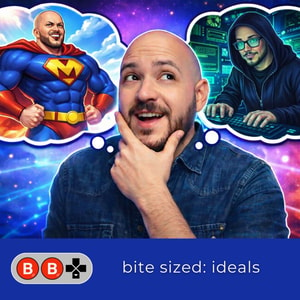
In this bite sized episode, Josh lays out a way of analyzing and evaluating games and media by focusing on what is shown to be ideal through the way that the medium communicates.
We'd love to hear from you! Join us on our social media by checking out our Linktree: https://linktr.ee/thebacklogbreakdown
And if you'd like to support us, you can visit our Patreon: https://www.patreon.com/thebacklogbreakdown
The Backlog Breakdown is a proud member of the Play Well Network, a network of podcasts that seek to approach recreation in a more thoughtful manner. Until there is a rabbit trail to follow. Check out all of the other amazing Play Well podcasts at playwellnetwork.com. Get PWNed, scrubs.