
bite sized: disembodied
Transcript
Hey, loggers. Welcome back to another bite sized episode of the Backlog Breakdown. I am your host, Josh, and today I am Steve, seeking to encourage and equip the church to play well and wisely and responsibly with a kind of a bigger, kind of a heady concept here. Now this is a bite sized episode, which means that this is not a fully formed thought. This is not something that I've taken a ton of time to, to really dig into like we typically try and do on our normal episodes. But I do want to present something to you and hopefully encourage you in your, your play, in your recreation to do so well. And it stems from a question I was asking myself. So our next episode that'll be released next week, it has to do with the. The huge video game platform Roblox. And there are, within our conversation in researching Roblox, there are some aspects of it that we don't like that stems around the way that we interact on the Internet. And it just, it posed a question for me. Why are radical ideologies such as transgenderism and even this idea of being a furry or having, or really identifying with a different. With what you are, not what. I'm trying to gather my words here, which is not a great thing on a podcast. Right. You should already have this preformed. But these ideas that, that divorce us from our bodies and the ways that we are created and instead invite us to not just inhabit someone else or something else. Because I don't think there's anything, there's inherent, there's anything inherently wrong with that. I don't. But to then say that, to identify with something that is different than the way that you were created by God, and that is frankly radical. Okay, that's not something, you know, in 2026, it's not as uncommon as it was five, 10 years ago. I understand that. Um, but when we look at human history, that is a radical ideology. And so it just hit me, okay, how do we get here? You know, what is it that that drives this? And particularly, okay, there's, there's the cultural aspect to it. Yes. But I think about, in video game spaces, there are a number of prominent YouTube streamers, or, excuse me, streamers in general. Not just necessarily YouTube streamers, streamers, but also video game podcasters, video game journalists, and things like this that have accepted these ideas wholesale. I mean, when you think about, you know, conventions, nerd conventions, in video game conventions, it kind of goes hand in hand with cosplay, which again, there's nothing inherently wrong with cosplay. Itself, but with people that take that a step further and therefore identify with these other. Whether it's. Whether it's a different. A different. I don't know if you want to use the term gender, whatever. I. I believe sex and gender are the same thing because the Bible doesn't differentiate between them. So whether that is identifying with a different gender or whether that's identifying with a different spirit or a different animal or being or something like that. Why do these things? Why do they seem to be prevalent within video game spaces? And I think it has to do with the idea of disembodiment and the time that we spend outside of where our minds are inhabiting other places and other people and other things as opposed to physical reality and in working with our hands. Okay, so in saying that, I once again feel like I have to reiterate that this episode or these thoughts is not to condemn any one thing in particular, because I don't think. Okay, so, for instance, with video games, we inhabit an avatar, okay? And it was pointed out to me recently that in a lot of games, when you change your outward appearance in the game, it's called a skin, which, when you think about it, that's kind of a creepy concept, like, oh, I'm wearing a different skin. I. I much prefer the. The context of the. Of theater, where you're wearing a different mask or you're putting on a different Persona. I like that a lot more than, oh, I'm. I'm crawling into a different skin. That. That just has a little bit of a creepy connotation to it. Anyways, that's neither here nor there. That's a little bit of a sidebar. But when we inhabit these other avatars, I don't think there's anything wrong with that. I think actually that books and movies invite you to do the same thing, to put yourself in someone else's shoes for a little while, to see life from a different perspective. And I don't think there's anything wrong with that. In fact, I think it's very beneficial. Where I think the difference is, is that the more time that we spend inhabiting a. A different avatar, a different Persona, wearing a different mask, then the temptation is to identify more with that Persona than we do with the way that God has created us and our bodies and the life that we live in the. The place that we inhabit, that God has placed us in. We know that God is sovereign. We know that man makes his plans and God directs his steps. And so we ought to cultivate a thankfulness for our station in life. Of course, that's coupled with a bit of discontent because we're on mission, and there are things that we want to do and get done, whether that's career wise or whether that is evangelism, whether that's going out and sharing the gospel. So there's a little bit of. Because we have work to do. Yes, we're on mission, and yes, there are things that we want to change, but there's also recognition of humility before an almighty creator who has made us and made us the way that he wants us to be. So there's a little bit of a mixture there. Not 100% saying, oh, we need to absolutely be content with everything that we face in life. So when I get a debilitating sickness, I should just be content. I think we should be thankful to God for what he gives us. But I don't think that means that therefore we shouldn't, you know, take medicine or something along those lines, or we shouldn't go to a doctor and try and. And fix our bodies. But I do think it's a step too far when we move into the realms of, say, transhumanism, when we start to augment our bodies. And rather than seeing technology as a tool to help us, we start to identify with these technological tools, which I would say, to some extent are good gifts of God. But then we start identifying with that, and it becomes a part of us. And that is. That is what I think the temptation is, that once we start going down that road, it leads us to sin. And I think that it's because there is an element of. Rather than having faith in God and trust in God that. That he gives good gifts to his children. And viewing the things that he gives us as good gifts that we can then use in our lives, we start to say that this is actually who I am, and this is how I ought to be. And because I'm broken, which is a reality, you know, we are broken. But because I'm broken, I should be able to fix myself. And then a step farther than that is, hey, I'm not even necessarily broken. I just want to be something different. And so I'm discontented in what I have and what I've been given. And instead, I would rather. I would rather become a different kind of thing. So, again, my original question is, why is this prevalent within video game spaces? And I think it has to do with the time that we spend in disembodied spaces. So are just life in 2026. It almost requires I'll say American life in 2026, it almost requires that you have access to the Internet and that you understand how to integrate the Internet into your regular life. It's not altogether necessary, but I think a big part of the lives that we lead are disembodied. And so we take on these different Personas when we're online and I think we do that in video games as well. That we have different avatars that we play as that we can tend to that There is a temptation therefore to identify with that avatar and that leads us down a road to believe that we are malleable and that we can change who we are and what we are as easily as we, we put on a different, you know, we, we choose a different screen name or, or profile picture or, or skin, for lack of a better term for our online avatar. And so I, I just wanted to kind of throw this out here in a bite sized context that we ought to be careful, you know, that that temptation is real. That as we spend time in these different spaces, which I again is. There's nothing wrong with that. In fact, I think it's good to learn about different perspectives and points of view because we're not all seeing and all knowing and, and we can be wrong about things and we want to understand things from other vantage points and it helps us to know that we are not alone is what Louis said, is why we read books. And I think embodying someone else or at least attempting to view the world from someone else's eyes helps us to do that. But where I think one of the major points for me when I think about doing that is that I do that I put myself in someone else's shoes so that I can then take what I learned from that experience and bring it back to my own life. And I think that's the same in online interaction, is that rather than having a separate online life, I ought to view it as online tools and spaces are there for me to bring back the goodness of those things, you know, and spit out the bones, right? Eat the meat and spit out the bones. And those good things that I can learn in those spaces, I want to bring it back to my life and the way that I live my life. And similarly for video games. I don't play video games necessarily as a pure escape. And that's a big conversation that we can have that. But I think if we view playing video games as a form of recreation, then the things that I want to take from video games, I want to bring it back to my life. I want to recognize the experiences that I can have in video games are good experiences and I can enjoy them, but I can use them as a form of recreation so that I can then go and live on mission the rest of my life. And rest and recreation is a good thing that I can use in my life. That is a part of the rhythm that God has created within my life. Therefore, to help me to. I was going to use the word regenerate, but that's probably not the best word because usually that's tied to salvation. But that can help to, you know, just give me more energy for the rest of life as well, that I can think about things and think about experiences and think about, oh, what would I do in this moral dilemma, Something like that, that I can then bring back into my own life and, and my own understanding of ethical dilemmas and morals so that when I encounter these things in real life, I will have already had this playground in which I've been able to think through, through it, as opposed to no, I want to embody this other character. I. I've actually become a completely separate character. And therefore who I am in the real world IRL is not really who I am. And I think we see that temptation and I think that temptation is prevalent within our video gaming space because of the amount of time that we, that we can spend. I do think it also has to do with age and you know, at what age were you introduced to the Internet, things like that? Because I'll be honest, most of my, my avatars in video games, I don't tend to make them crazy or extreme. I know a lot of players do like to do that or like to change the gender of the person that they play as. And I generally try and keep it similar to who I am. That's just naturally what I do. But, um, again, it's not necessarily right or wrong if you would prefer to play as, you know, something different. But I just want to point out that the temptation is there. The temptation towards discontentment in who you are, the temptation towards, oh, things would be better if I was. Was different and therefore identifying with something different. And instead we ought to cultivate thankfulness for what God has given to us. And that is coupled with a responsibility of how God has made us. And therefore, what ought we to do with the gifts that we have, with the skills that we have, and with the life that he has given us. Take a look at your responsibilities and therefore how ought we to live? So hopefully this has been an encouragement. I have to reiterate that because this is a bite sized, it's not a fully formed thought. So there's. There are plenty of other perspectives, and I'd love to hear what you have to say on this idea of disembodiment, of discontentment, of good gifts, of a sovereign God. You know, I've kind of gone a little bit all over the place, but I'd love to hear what you have to say. So reach out. And until next time, guys, keep beating down your backlogs. We'll keep breaking down the benefits. Sam.
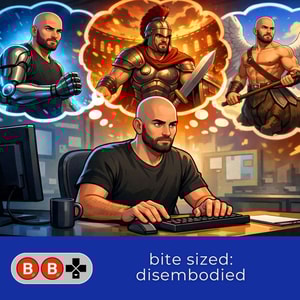
Why have radical ideas that divorce who we are as people from the physical realities of our bodies become so popular in recent years within the gaming space?
We'd love to hear from you! Join us on our social media by checking out our Linktree: https://linktr.ee/thebacklogbreakdown
And if you'd like to support us, you can visit our Patreon: https://www.patreon.com/thebacklogbreakdown
The Backlog Breakdown is a proud member of the Play Well Network, a network of podcasts that seek to approach recreation in a more thoughtful manner. Until there is a rabbit trail to follow. Check out all of the other amazing Play Well podcasts at playwellnetwork.com. Get PWNed, scrubs.